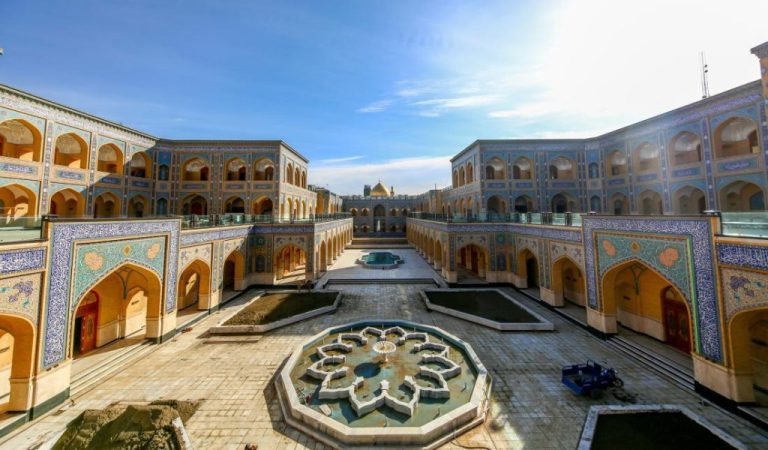
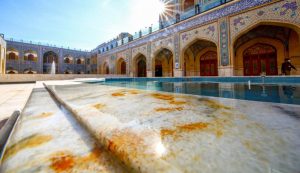
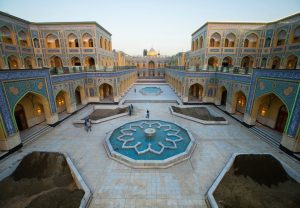
The ever-growing presence of pilgrims and devotees of Imam Ali (peace be upon him) from across the world led the custodians of the Holy Shrine to embark on an expansion project. The first stage of this development was the construction of the Courtyard and Underground Hall of Lady Fatima al-Zahra (peace be upon her).
This monumental project addressed two long-standing needs: the expansion of the shrine—an effort historically supported by great scholars and engineers such as Shaikh al-Bahai—and the creation of an enduring dedication in the name of the beloved daughter of the Prophet Muhammad (peace be upon him and his family).
Engineering and Construction
The western side of the shrine, between the Abu Talib portico and the Station of Imam Sajjad, was selected after extensive study as the most suitable location. The work involved advanced soil stabilization, including the installation of nearly one thousand pilings, each twenty-five meters deep, to reinforce the perimeter. Excavation covered an area of 150 meters by 400 meters, at a depth of 17 meters, with measures taken to manage groundwater and prevent soil collapse.
A major innovation was the waterproofing system, executed with precision by Iranian engineers. The concrete used was a newly developed, highly durable blend.
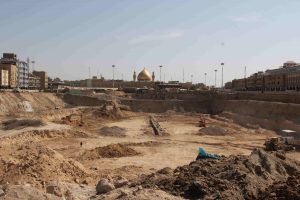
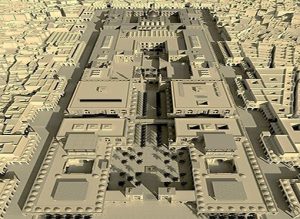
To preserve visibility of the shrine’s central dome, the design adopted a challenging yet successful solution: three underground levels and one above ground. Mechanical systems were located 500 meters away to minimize noise pollution, with air conditioning, heating, and ventilation carried into the hall through vast tunnels.
Design and Architecture
The hall’s design was entrusted to a team of architects from Shahid Beheshti University in Iran, drawing on classical Islamic–Persian architectural principles.
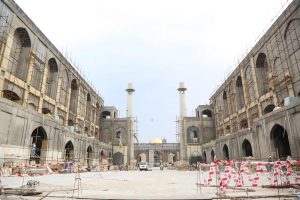
The project is divided into pilgrimage spaces and non-pilgrimage facilities, ensuring both spiritual and practical needs are met.
Pilgrimage Section
- Built over 29,000 square meters, with a total floor area of 85,000 square meters across 4 main levels and 3 mezzanines.
- Accommodates up to 100,000 worshippers per hour.
- Includes prayer halls, a seminary, a medical center, service areas, storage, and sanitary facilities.
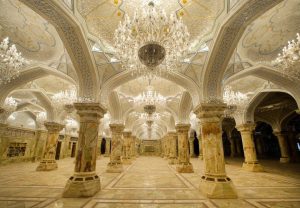
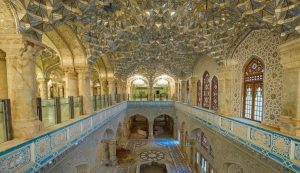
- Interior decorations feature more than 1,200 stone pillars, each floor adorned with distinct stonework, and over 800 internal domes.
Non-Pilgrimage Section
- Administrative and Information Complex: 4,400 m² of land, 15,000 m² built space, housing offices, engineering divisions, meeting halls, and service areas.
- Library: 3,100 m² plot, 12,000 m² structure, with capacity for 250,000 volumes across 6 levels.
- Guesthouse and Shrine Restaurant: 4,400 m² land, 14,500 m² structure, capable of preparing 10,000 meals per sitting.
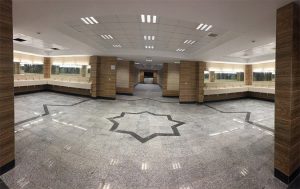
- Ablution Facilities: 15,000 m², with 900 restrooms, capable of serving over 140,000 pilgrims alongside existing facilities.
- Dedicated Parking: 10,000 m² capacity.
- Museum: 3,100 m² land, 18,000 m² facility over 6 floors.
 This expansion stands as one of the most ambitious shrine development projects in the Islamic world, combining spiritual devotion with architectural and engineering mastery.
- Administrative and Information Complex: 4,400 m² of land, 15,000 m² built space, housing offices, engineering divisions, meeting halls, and service areas.