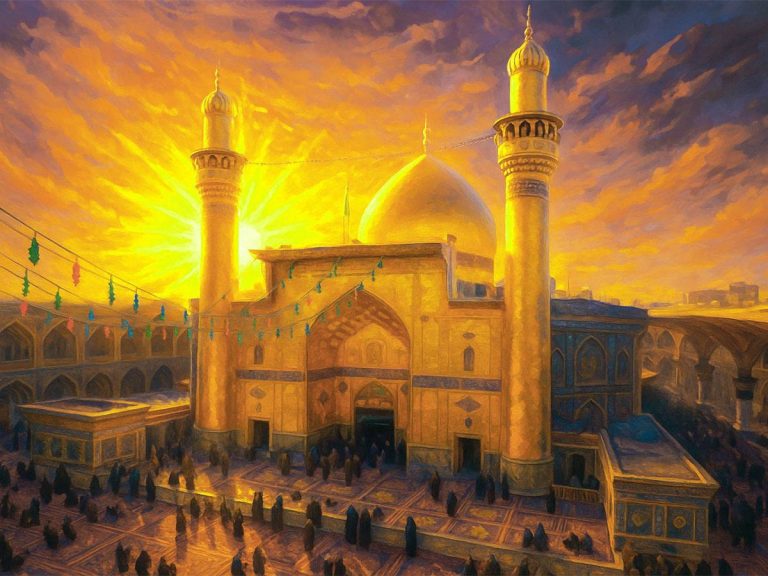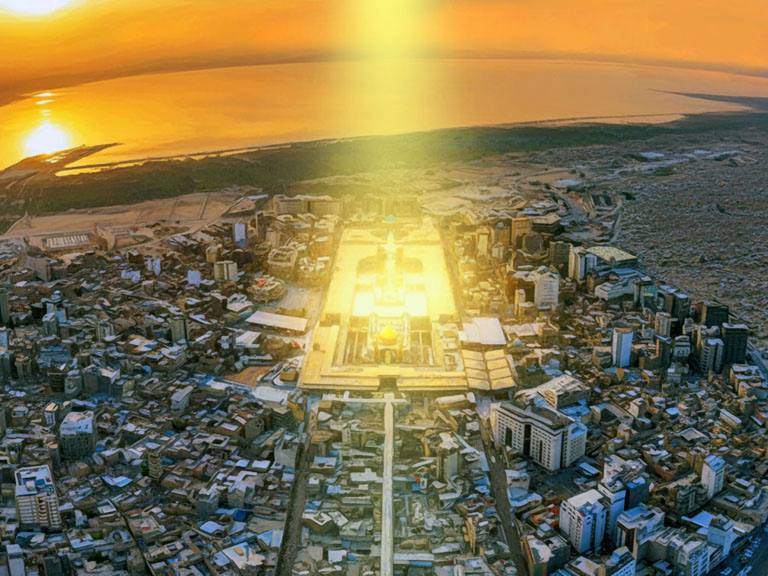
he At the heart of this sanctified city lies the holy shrine of Imam Ali (peace be upon him). It is the radiant source of its spiritual prestige and the beating heart of Najaf. His blessed mausoleum has long been a sanctuary for countless devotees and seekers of divine proximity. It draws millions of pilgrims from every corner of the world.
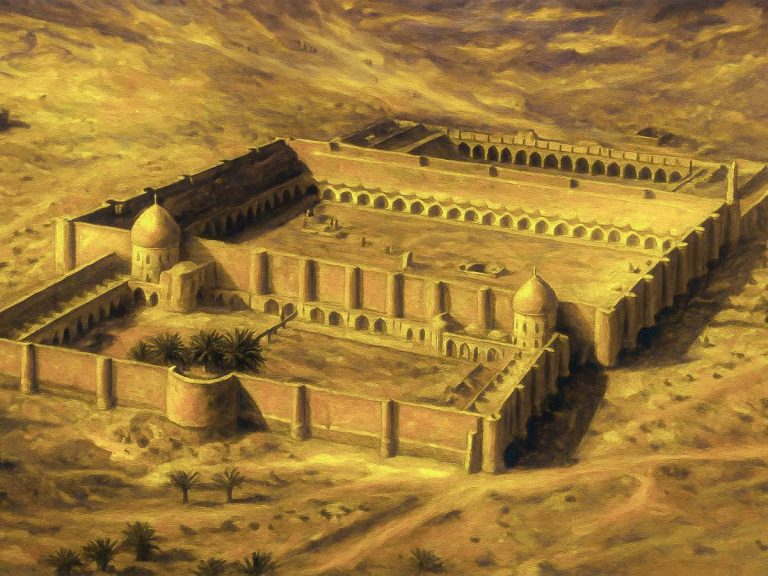
The intellectual awakening of Najaf traces its roots to the great School of Kufa. From there, a number of Shia scholars and seekers of knowledge migrated to Najaf in the early fourth century AH, establishing it as a new center of religious authority. During the era of the Buyid dynasty, Najaf flourished remarkably in learning and urban development. Many scholarly families settled in the city under the dynasty’s patronage.
The Early Scholars of Najaf
In the year 296 AH, Hussain ibn Ahmad, known as al-Mastur or al-Maktum, journeyed to Najaf to visit the shrine of Imam Ali (peace be upon him). During his stay, he met several prominent scholars, including Abu al-Qasim Hussain ibn Ruh and Ali ibn Fadl.
A few years later, in 308 AH, Sayed Sharif al-Din Muhammad, known as Ibn al-Sadra, took residence in Najaf. He assumed the position of naqib al-ulama (chief of scholars). His family, thereafter known as Al al-Sadra, remained in Najaf for generations.
Shaikh Ahmad ibn Ali al-Najashi records in his Rijal that he met Ishaq ibn Hasan al-Uqrai al-Tammar in Kufa and transmitted from him the works of al-Kulayni. The Shaikh Agha Buzurg al-Tehrani later noted that the term mujawir (one who resides near a holy shrine) in this context implies permanent residence in Najaf rather than temporary visitation.
Shaikh al-Najashi himself visited Najaf in 400 AH. There, he met notable scholars such as Shaikh Abu Nasr Hibatullah ibn Ahmad ibn Muhammad (Ibn Barinah) and his teacher Abu Abdullah ibn Khumri.
The Flourishing of Najaf’s Scholarly Movement
By the late fourth century AH, Najaf had emerged as a vibrant hub of learning. Its intellectual life revolved around the courtyard of the Holy Shrine, which became a haven for seekers of knowledge and virtue. The words of the Holy Prophet (peace be upon him and his family)—“I am the City of Knowledge, and Ali is its Gate; whoever seeks knowledge must enter through its gate”—found visible manifestation in this sacred space.
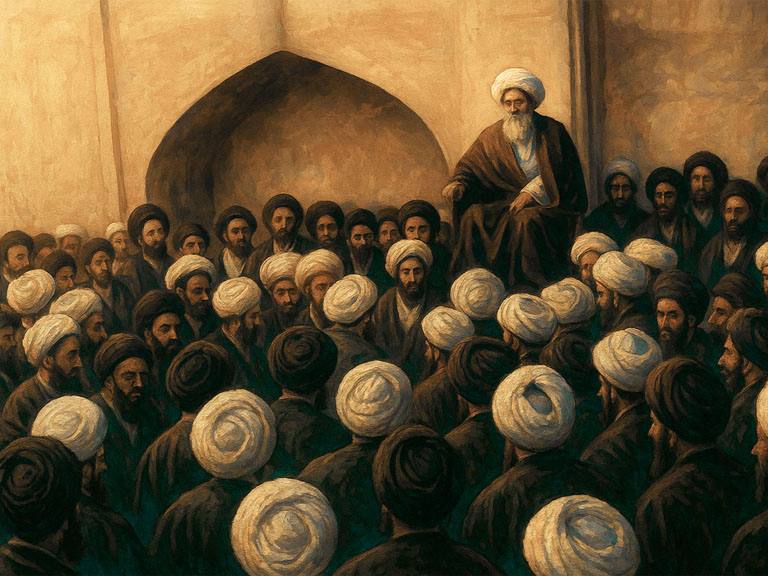
A decisive turning point came with the migration of Shaikh al-Taifa Abu Jafar Muhammad ibn Hasan al-Tusi from Baghdad to Najaf in 448 AH. Through his organizational vision and prolific writings in jurisprudence, theology, hadith, and exegesis, he laid the foundations of the Najaf Seminary. He consolidated its status as the center of Shia religious authority. Following his demise in 460 AH, Najaf rapidly evolved into one of the greatest centers of learning in the Islamic world.
In the ensuing centuries, leading jurists and scholars established numerous seminaries throughout Najaf, particularly around the Holy Shrine and the Gharawi School. These institutions nurtured generations of scholars, jurists, and intellectuals whose influence spread throughout the Muslim world.
Beyond jurisprudence and theology, Najaf also became home to eminent poets, writers, and orators, further enriching its cultural and intellectual heritage.
Najaf’s Libraries—Treasuries of Knowledge
Najaf earned renown for its treasured libraries and manuscript collections, which preserved thousands of rare and invaluable works. Among these, the Rawdat al-Haydariya Library held a position of exceptional prestige, serving as a repository of Islamic heritage and a testament to Najaf’s scholarly eminence.
The city’s intellectual vitality also fostered a thriving publishing culture. By the early fourteenth century AH, Najaf had become a hub of printing and journalism. Indeed, Iraq’s first Arabic-language periodical, al-Ilm, was published in Najaf in 1328 AH under the editorship of the eminent scholar Muhammad Ali Hibat al-Din al-Shahrastani.
For nearly a millennium, Najaf has remained a beacon of learning and spiritual leadership—guiding the faithful, educating scholars, and spreading the message of the Ahl al-Bayt (peace be upon them) across the world. Even today, its seminaries attract students and researchers from every continent, continuing an unbroken legacy of faith, intellect, and devotion.
Najaf in the Era of the Reappearance
The Imams of the Ahl al-Bayt (peace be upon them) accorded the land of Iraq a uniquely exalted status. Imam Ali (peace be upon him), aware of Najaf’s divine significance, transferred the capital of the Islamic caliphate from Madinah to Kufa in 36 AH. This move reflected the spiritual and strategic importance of the sacred region.
Numerous narrations affirm that Iraq, particularly Najaf and Kufa, will play a central role in the Divine Plan of the Awaited Imam al-Mahdi (may Allah hasten his reappearance). According to these traditions, the Imam will raise the banner of truth from Najaf, and his global movement for justice will commence from this sanctified land.
Imam Muhammad al-Baqir (peace be upon him) said to Abu Hamza al-Thumali:
“O Thabit, it is as though I see the Qaim of my family manifest upon the heights of your Najaf, raising the Banner of the Messenger of Allah. When he unfurls it, the angels of Badr will descend upon him… Its staff is from the pillars of the Divine Throne, and its fabric is from the mercy and victory of Allah. Wherever that banner descends, falsehood is obliterated.”
Likewise, Imam al-Hasan al-Askari (peace be upon him) foretold:
“He (the Mahdi) shall have an occultation in which the ignorant will stray, the misguided will perish, and those who set a time for his advent will lie. Then he shall appear, and I see the white banners fluttering above his head in Najaf of Kufa.”
In another narration, Imam Jafar al-Sadiq (peace be upon him) said to his companion al-Mufaddal:
“The abode of al-Mahdi shall be Kufa; his court of justice will be the Great Mosque of Kufa; his treasury and the place of distributing spoils will be the Mosque of al-Sahla; and his private retreat will be the hills of Najaf.”
Thus, Najaf shall once again shine as the epicenter of divine governance and enlightenment, from which the banner of pure Muhammadan Islam shall rise to encompass the entire world.