A question may be asked: How, and for what reason, did Imam Ali (peace be upon him) come to reside in Kufa?
After the conclusion of the Battle of Jamal in Basra, Amir al-Muminin (peace be upon him) entered Kufa in victory and, on the twelfth of Rajab in the year 36 AH, designated it as the new capital of the Islamic state.
His Praise for the People of Kufa
The Imam (peace be upon him) spoke on numerous occasions in praise of Kufa and its people. Among his noble sayings:
“Kufa is the skull of Islam and the treasury of faith; it is the sword of God, which He places wherever He wills. By God, He shall aid the people of Kufa in the East and the West, just as He aided through the people of Hijaz.”
He also praised the people of Kufa in a letter written while departing from Madinah toward Basra for the confrontation with the Nakithin, addressing them as
“From the servant of God, Ali, Amir al-Muminin, to the people of Kufa, the foremost among supporters and the noblest lineage among the Arabs.”
Yet it was the divine decree that his martyrdom would occur in this very city.
The Martyrdom of Amir al-Muminin (peace be upon him)
He attained martyrdom on the night of the twenty-first of Ramadan in the year 40 AH, at the age of 63, after receiving a poisoned strike upon his head from Abd al-Rahman ibn Muljam al-Muradi.
Shaikh al-Mufid writes:
“The martyrdom of Amir al-Muminin (peace be upon him) took place before dawn on Friday, the night of the twenty-first of Ramadan in the fortieth year after the Hijra. Ibn Muljam had lain in wait for him in the Mosque of Kufa. The Imam entered the mosque on the nineteenth to awaken the people for the dawn prayer. Ibn Muljam, pretending to sleep, suddenly rose and struck him with a poisoned sword. The Imam remained wounded for two days until he attained martyrdom at the beginning of the night of the twenty-first. He departed this world with full awareness of the event by divine permission, having informed the people of what was to come.”
His Will Regarding Burial in Najaf
Before his martyrdom, the Commander of the Faithful (peace be upon him) instructed that he be buried in the land of Najaf, a place he repeatedly praised and referred to as “Wadi al-Salam,” the resting place of believing souls and the finest abode for the graves of the faithful.
Narrations state that the burial site of Imam Ali (peace be upon him) lies where earlier the bodies of the great prophets Adam, Noah, Hud, and Salih (peace be upon them) had been buried. Visitation supplication also attests to this sanctified lineage, referring to him as “the tree of prophethood and the fruitful tree of Imamate.”
According to the narration of Imam al-Baqir (peace be upon him), the Prophet Muhammad (peace be upon him and his family), accompanied by the nearest angels, undertook the burial of Amir al-Muminin (peace be upon him), placing him beside his forefather Prophet Noah (peace be upon him).
Testimonies on the Manner of His Funeral
After receiving the fatal blow, Imam al-Hasan (peace be upon him) sought permission to execute Ibn Muljam, but the Imam instructed:
“Keep him alive. If I die, then enact retribution; if I recover, I will determine his fate. After my martyrdom, bury me in this land beside my brothers Hud and Salih.”
Another report relates that before his martyrdom, the Imam instructed his sons al-Hasan and al-Hussain (peace be upon them) to wash and shroud him secretly at night, apply the perfumed burial ointment, and place him in the prepared grave. Present at the burial were al-Hasan and al-Hussain (peace be upon them), Muhammad ibn al-Hanafiyya, and Abdullah ibn Jafar.
He had also foretold that the Prophet Muhammad (peace be upon him and his family) had previously indicated the location of his burial.
Accounts of the Procession to the Burial Site
Umm Kulthum, the daughter of the Imam, narrates that he instructed his children:
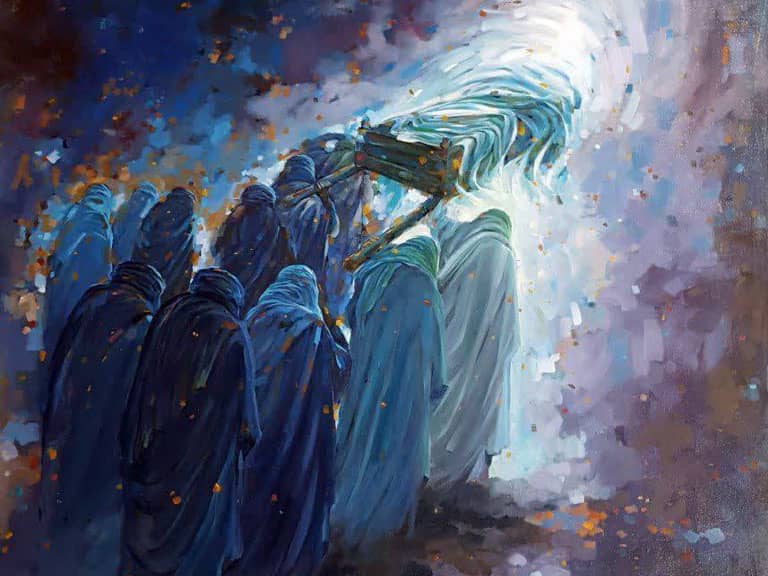
“When I depart from this world, wash me, then dry me with the cloth of the Prophet Muhammad (peace be upon him and his family) and Lady Fatima (peace be upon her). Apply the burial ointment and place me on my bier. When you see the front of my bier rise on its own, raise only the back and follow it.”
She continues:
“I accompanied the bier until we reached the land of Ghari. There the bier stopped. Imam al-Hasan (peace be upon him) began digging the earth when a prepared grave appeared, containing a wooden plank with a Syriac inscription: ‘In the name of God, the Most Merciful, the Most Compassionate. This is the grave of the Prophet Noah, prepared seven hundred years before the Flood for Amir al-Muminin.’”
She further relates that she heard a voice offering condolences, saying, “May God grant you patience and reward for the martyrdom of your master and the proof of God over His creation.”
Other narrations reinforce that the bier progressed miraculously until reaching a luminous stone in the area of “Gharibayn,” where a prepared grave awaited, bearing the inscription: “This was prepared by Noah for Ali ibn Abi Talib (peace be upon him).”
After the burial, when others returned hoping to witness what had occurred, they found no trace of the grave, in accordance with the Imam’s instruction that its location remain concealed.
A Final Testimony
Sadd al-Sikkaf relates from Imam al-Baqir (peace be upon him):
“When Amir al-Muminin (peace be upon him) was struck and approached martyrdom, he instructed al-Hasan and al-Hussain (peace be upon them): ‘Wash me, shroud me, and apply the burial ointment. Then carry the bier as I have told you; the front will move on its own. You will be led to a prepared grave with its chambers and bricks in place. Bury me there. Afterward, remove the brick near my head and listen.’”
They did so, and they heard a voice proclaim,
“Amir al-Muminin Ali (peace be upon him) was a righteous servant whom God has joined to His Prophet. Such is the station of all successors of the prophets, even if a prophet should die in the East and his successor in the West—God shall unite them.”