Certain historical accounts also report that Harun al-Rashid visited the grave of Amir al-Muminin (peace be upon him) at a time when the burial site was allegedly concealed and unknown to the public. Sayed Abd al-Karim ibn Tawus, in his work Farhat al-Ghari, writes:
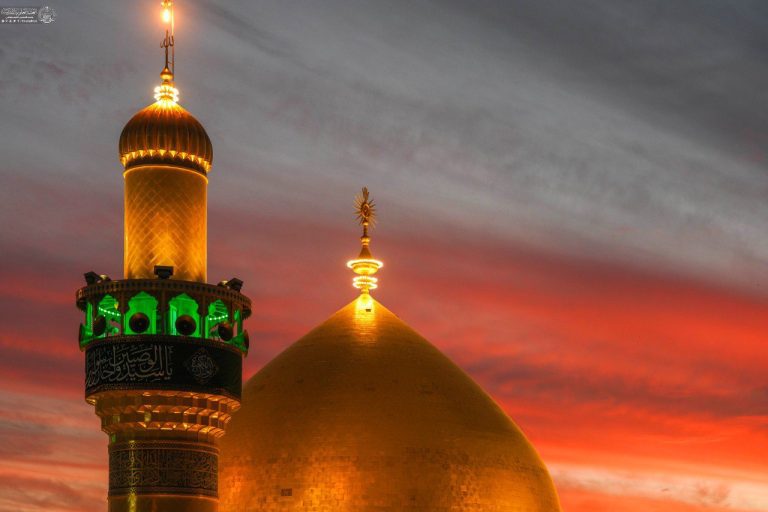
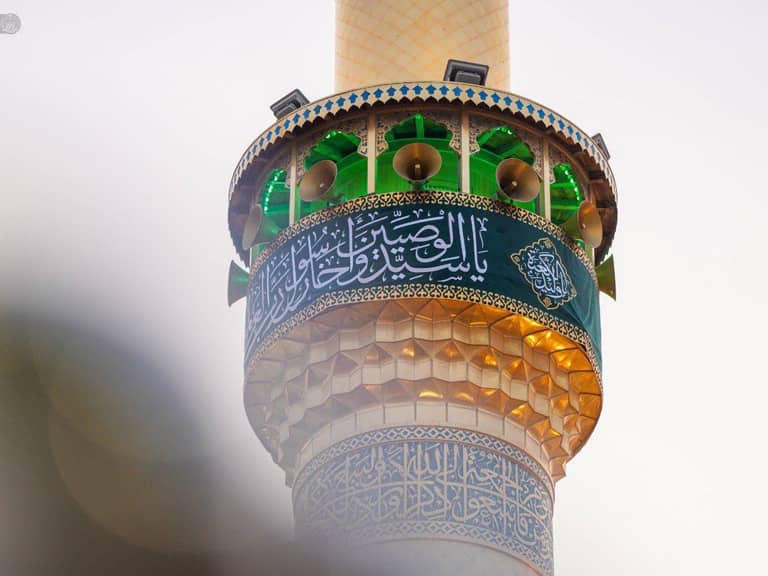
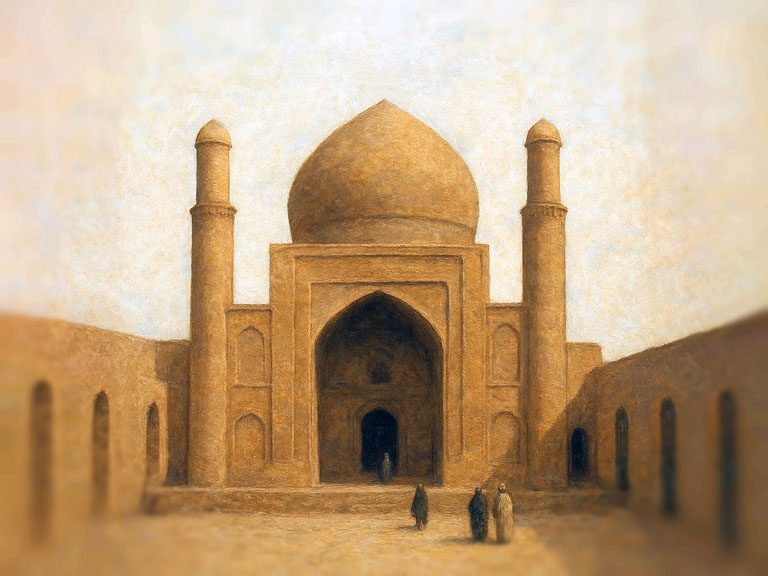
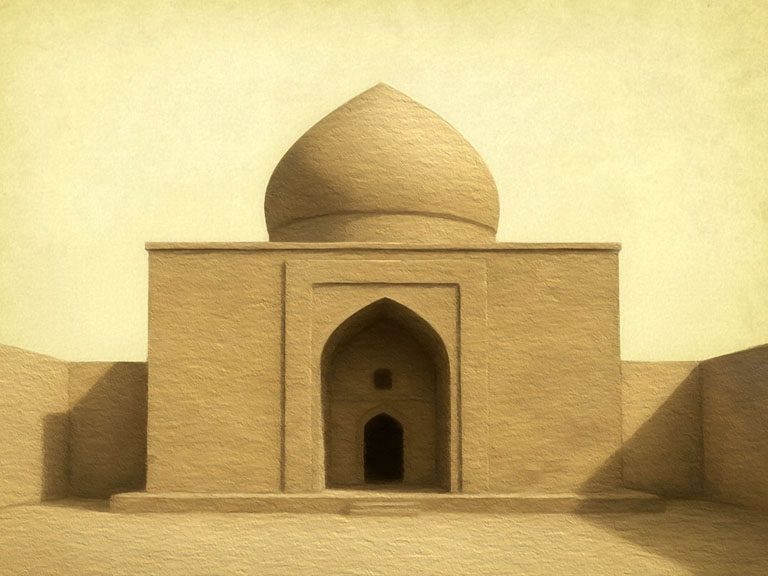
“Ibn Tuhal reported: Harun constructed a small structure of white bricks over the grave, smaller than the present-day shrine. When we opened the sacred enclosure, we found that it was made of earth and gypsum. Harun then ordered the construction of a qubba (dome) over it; subsequently, a dome of red clay was built, and above it a green dome was placed, which remains preserved in the treasury to this day.”
Some authors have transmitted this report from Ibn Tawus and accepted it as an established fact without critical examination or analytical scrutiny. Among them is Hasan al-Daylami, a scholar of the ninth century AH, who wrote:
“Harun ordered that a dome with four doors be constructed over it. This structure was built and remained standing until the reign of Adud al-Dawla.”
Grounds for Rejecting the Claim Attributed to Harun al-Rashid
First: This report lacks an authentic chain of transmission and is narrated in a disconnected (mursal) form, with no identified series of transmitters. Moreover, for more than five centuries following the well-known hunting incident dated to 170 or 175 AH—an event during which Harun is said to have discovered the holy grave—no historical source mentions the construction of any such building until the time of Sayed Ibn Tawus (d. 693 AH).
A review of major historical works such as Tarikh al-Yaqubi (d. 292 AH), Tarikh al-Tabari (d. 310 AH), Tarikh al-Masudi (d. 346 AH), and Tarikh Ibn al-Athir (d. 639 AH) confirms the complete absence of any reference to such a structure. Had Harun truly undertaken such an act, these historians would undoubtedly have recorded it. Notably, even the hunting episode itself—often cited with extensive detail—does not appear in these authoritative sources, further underscoring the weakness and unreliability of the claim.
The Hunting Incident According to Shaikh al-Mufid
Shaikh al-Mufid (d. 413 AH), in his seminal work al-Irshad, recounts Harun al-Rashid’s arrival in Najaf and his encounter with the location of the holy grave of Amir al-Muminin (peace be upon him), yet makes no mention whatsoever of any construction or building activity.
He narrates the incident solely as follows:
Muhammad ibn Zakariya reports, on the authority of Ubayd Allah ibn Muhammad ibn Aisha, who in turn relates from Abd Allah ibn Khazim:
“One day, we went hunting with Harun al-Rashid from Kufa until we reached the area of al-Ghariyyayn and al-Thuwayya. We spotted gazelles and released the falcons and hunting dogs after them. The gazelles fled until they reached a hill and stood upon it, whereupon the falcons and dogs approached but then retreated. Harun was astonished by this.
This occurred three times. Harun then ordered that anyone found in the area be brought to him. An elderly man from the tribe of Banu Asad was brought before him. Harun asked him about the hill. The man said, ‘If you grant me safety, I will tell you the truth.’ Harun swore to grant him protection. The man replied, ‘My father narrated to me from his forefathers that this is the grave of Ali ibn Abi Talib (peace be upon him). God has made it a sanctuary in which whoever seeks refuge is granted safety.’
Harun dismounted, requested water, performed ablution, and prayed beside the hill, then fell to the ground weeping, after which we departed.”
Kamal al-Din Muhammad ibn Musa al-Damiri (d. 808 AH), a prominent Egyptian scholar, similarly reports—citing Ibn Khallikan—the same hunting account, adding only that Harun ordered the site to be enclosed (made a hijr). He explicitly states that the foundational construction of the shrine occurred during the Buyid period, not under Harun al-Rashid.
Refutation of al-Damiri’s Claim through the Report of Safwan al-Jammal
It must be emphasized that Imam Jafar al-Sadiq (peace be upon him) was the first to designate and establish the foundations of the holy shrine of Amir al-Muminin (peace be upon him).
Safwan al-Jammal narrates:
“Imam al-Sadiq (peace be upon him) stood, placed his blessed hand upon the ground, took a handful of earth, smelled it, then proceeded to the location of the present grave. He gathered the soil again, inhaled deeply, and I thought he had passed away. When he regained consciousness, he said, “This is the mashhad (shrine) of Amir al-Muminin (peace be upon him),” and then he marked it.
The phrase “then he marked it” clearly indicates an act of designation and delineation, thereby invalidating al-Damiri’s claim that Harun al-Rashid was the first to establish the grave site.
The Absence of Dome Construction Practices in Harun al-Rashid’s Era
Second: The construction of domes over graves was unknown in the Islamic world during the first two centuries AH. The earliest known dome built over a burial site dates to 248 AH in Iraq, over the grave of the Abbasid caliph al-Muntasir ibn al-Mutawakkil, known as the Qubbat al-Sulaybiyya in Samarra, which remains standing to this day.
Multiple historians and researchers—including Khayr al-Din al-Zirikli, Dr. Suad Mahir, Ata Hadithi, Hana Abd al-Khaliq, Dr. Isa Salman, Jafar al-Khayyat, and K.A.C. Creswell—affirm that this structure is the earliest surviving domed mausoleum in Islamic history. Had the practice of building domes over graves existed earlier, numerous such structures would have survived over the graves of Umayyad and Abbasid caliphs, which is demonstrably not the case.
Developments Following the Destruction of the Holy Grave
Third: After al-Mutawakkil ordered the destruction of the holy grave of Amir al-Muminin (peace be upon him), only symbolic stones were placed to mark its location. The area remained an open, undeveloped expanse, not yet inhabited or urbanized.
Accounts of Shia pilgrims visiting the grave around 263 AH confirm that no structure existed at the site at that time. One such report, transmitted by Ibn Tawus from Muhammad ibn Ali ibn Dahim al-Shaybani, states that the grave was merely enclosed by simple stones, with no building or constructed edifice whatsoever.
This corroborates the established historical conclusion that the city of Najaf al-Ashraf emerged around 283 AH and that the first actual structure over the holy grave was erected by Sayed Muhammad ibn Zayd al-Dai al-Hasani.
Documented Hostility of Harun al-Rashid toward the Ahl al-Bayt (peace be upon them)
Fourth: The notion that Harun al-Rashid would honor the grave of Imam Ali (peace be upon him) by constructing a building over it is fundamentally inconsistent with well-documented historical accounts of his hostility toward the Ahl al-Bayt (peace be upon them), including the persecution and execution of their followers.
Among his most notorious actions were the destruction of the grave of Imam al-Hussain (peace be upon him) and the prohibition of pilgrimage to it. Authoritative reports from Shaikh al-Tusi, Sayed al-Karki, and others document these acts in detail.
Furthermore, Harun al-Rashid was directly responsible for the imprisonment and martyrdom of Imam Musa al-Kadhim (peace be upon him), as established in the narrations of Shaikh al-Saduq and Shaikh al-Tabarsi.
Conclusion
In light of the cumulative historical evidence and critical analysis of early sources, it becomes unequivocally clear that Harun al-Rashid played no role whatsoever in revealing the holy grave of the Commander of the Faithful, Imam Ali (peace be upon him), nor in constructing any structure over it.
The grave remained concealed during the Umayyad period, and it was Imam Jafar al-Sadiq (peace be upon him) who first made its location known. The earliest physical structure erected over the sacred site was commissioned by Sayed Muhammad ibn Zayd al-Dai al-Hasani, in fulfillment of a divinely inspired narration transmitted from Imam al-Sadiq (peace be upon him), which stands as the most authoritative and definitive evidence on this matter.